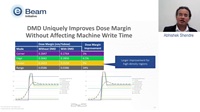
Mask process correction (MPC) solutions correct the shapes output by optical proximity correction (OPC) or inverse lithography technology (ILT), so that what OPC/ILT assumed would be the manufactured mask actually is what ends up being manufactured reliably, countering distortions that occur during the mask manufacturing process. Traditionally, MPC solutions have focused on solutions for linearity, but not as much on solutions for uniformity. This leaves the door open for mask variation that leads to wafer variation. Reducing mask variation is the most cost-effective way to reduce wafer variation.
Because D2S focuses on “uniformity first,” D2S pixel-level dose correction (PLDC) is an advanced MPC solution that includes leading-edge technologies to correct for both uniformity and linearity. PLDC is a computational operation that is performed for multi-beam mask writing, and can be performed either offline or inline. Inline PLDC, available on NuFlare multi-beam mask writers, results in no additional turnaround time (TAT) with the mask writer reading the ILT output and making dose correction for uniformity and linearity improvement while the machine writes the mask.
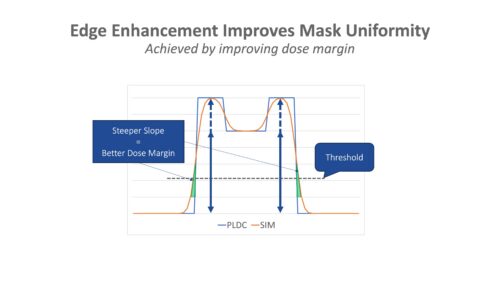
D2S PLDC determines the pixel dose needed for each pixel written by the multi-beam mask writer to perform all MPC functions, to produce as closely as possible on mask the target shapes output by OPC/ILT with steeper dose slope. Steeper dose slope – better dose margin (DM) – is known to be a good proxy for resilience to most types of mask manufacturing variation.
D2S PLDC employs patented technologies to correct for dose-based physical effects with % dose modification and geometric physical effects such as etching with nm-based geometric bias. Large-scale geometric effects are corrected by region-by-region radial bias (RRBias) where individual regions of the reticle can specify a radial nanometer bias map. For example, RRBias can be used to measure radial biases observed in a first writing of a mask, then apply the inverse of those biases in the second writing of the same mask. Another example is using RRBias to perform geometric loading effect correction (gLEC), which should be used instead of the dose-based LEC because loading effect is a geometric effect of the exposed shapes, independent of the doses used to expose those shapes. It is “radial” in that the bias can be specified with a smoothly varying nanometer bias around the shape, depending on the tangent along the contour.
Shorter-range geometric effects are corrected by visible-open, area-based variable bias. Forward scatter dose-based effects are corrected by dose-correction in D2S PLDC, while backscatter effects including proximity effect correction (PEC) and fogging effect correction (FEC) are applied by the mask writer, and accounted for in the D2S PLDC corrections.
All corrections are performed with edge-dose enhancement with dynamic maximum dose (DMD). D2S PLDC combines all corrections together to avoid one correction rendering another correction inaccurate.
Paper presented at SPIE Photomask Technology + EUV Conference 2026
D2S PLDC enables dose enhancement of pixels on/near contour edges to improve DM.

For all leading-edge mask making processes that are written by multi-beam mask writers, the dose-based effects and the variable-etch-bias-based effects both contribute significantly – and differently – to the linearity problem. Neither model alone is sufficient to correct linearity.
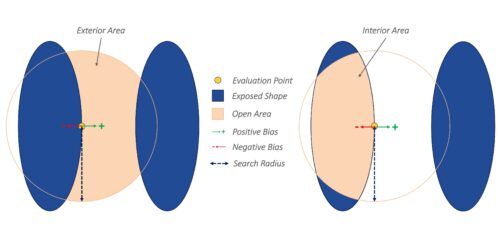
Variable bias includes a combination of resist and etch effects that occur when processing a photomask. After resist is exposed, and dose-based effects have taken place, other mask making steps occur including etching. After some of those steps, some areas of the mask are protected by hardened resist from etching, while other areas are left open to etching that “drills” down a certain known distance into the material under the resist. Even though this etching process is sophisticated and drills down much more than to the side, a certain amount of etching to the side is inevitable, which effectively increases the etched area. The linearity issue from variable bias occurs because the amount of that sideways etching is not identical everywhere.
To model this, etched areas visible to each point along the contour edge must be considered.
Figure 2 shows etched and non-etched areas: etched shown in blue in this positive resist example, and unetched in white. There are two radii, one on the exterior area outside the etched feature and one on the interior area of the etched feature.
D2S PLDC uses several mechanisms to improve both local uniformity and global uniformity.
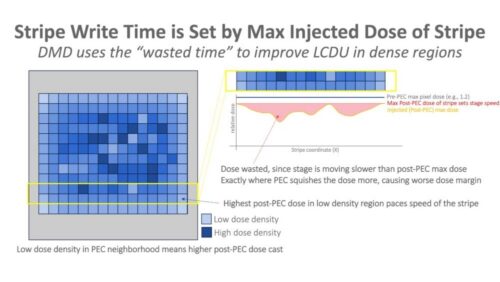
The D2S patented dynamic maximum dose (DMD) capability is a mechanism that improves dose margin in high-pattern-density regions of a mask. DMD takes advantage of the fact that masks are written in stripes at a constant speed that is set by the maximum injected dose of the stripe, which is dependent on the pattern density of the stripe. Not all features within a given stripe will need this maximum dose, so write time is “wasted” in some areas. As shown in Figure 3, DMD reclaims this “wasted” time to dynamically adjust the maximum dose to improve the local uniformity of dense regions, which generally have worse dose margin than sparse regions.
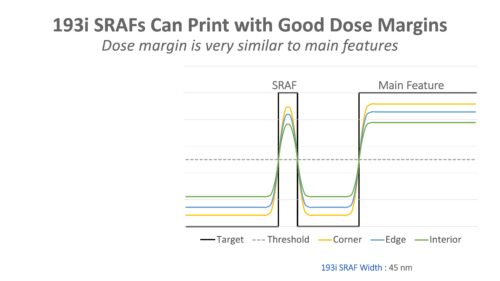
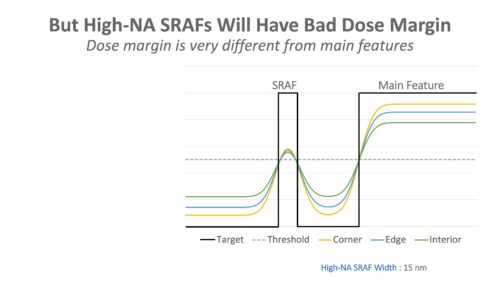
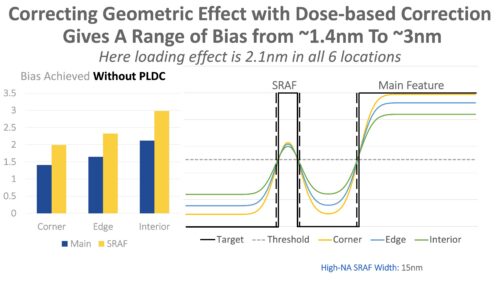
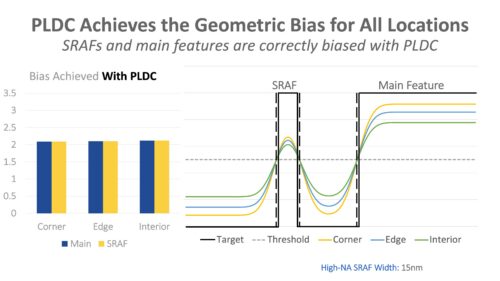
Features on mask continue to get smaller. In High-NA EUV processes, sub-resolution assist features (SRAF) with widths of 15-20nm are anticipated. Smaller features will have worse dose margin than larger main features, causing issues with global uniformity. This means that using dose-based biasing will be inaccurate. D2S patented gLEC technology addresses this through a 3D geometric bias (one dimension for angle and two spatial dimensions) to correct for geometric effects, as shown in Figures 4-7.
D2S PLDC provides MPC as part of the multi-beam mask writing process, either inline with mask writing, or offline as a separate step before mask writing. For those using NuFlare Technologies MBM-2000PLUS, 3000, or 4000 multi-beam mask writers, D2S PLDC works inline, performing dose corrections as masks are written. The inline D2S PLDC flow requires no additional TAT.
With both IMS and NuFlare multi-beam mask writers, offline PLDC improves uniformity for all shapes, Manhattan or curvilinear, and performs linearity correction for both dose-based models and variable bias-based models.
Unlike traditional MPC solutions, which were developed to handle primarily Manhattan mask shapes, D2S PLDC operates in the pixel domain. D2S PLDC provides MPC with superior uniformity and linearity for any mask shape with the same processing time and cost, including Entirely Manufacturable™, and therefore entirely curvilinear full-reticle designs.